
Virtual Tennis Betting Odds and Simulated Markets
 Available in US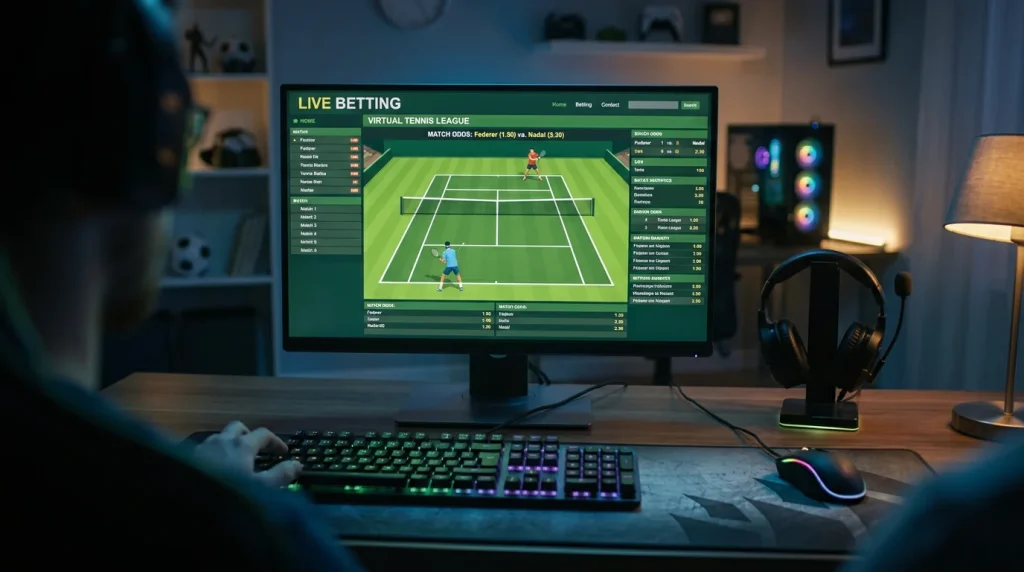
Analyzing 24/7 Virtual Tennis Betting Mechanics
The first time I placed a virtual tennis bet, I treated it like a real match. I checked serve statistics, reviewed recent form, and looked for surface data. None of it existed, because the “players” were not real people, they were algorithmic profiles with pre-assigned win probabilities, and the match outcome was determined by a random number generator before the first virtual ball was struck. That experience taught me the most important lesson about virtual tennis: it is not tennis. It is a number game with a tennis skin, and treating it otherwise is the fastest way to misallocate time and money.
Virtual tennis is available 24 hours a day, 365 days a year, with new matches starting every 2-3 minutes. The product exists to fill the gaps in the live tennis calendar, late at night, during off-days, and during the brief December-January off-season. Tennis betting is growing at 13.83% CAGR through 2031 according to Mordor Intelligence, and virtual tennis contributes to that growth by providing constant betting availability for punters who want tennis-themed markets regardless of whether real matches are being played.
How RNG Powers Virtual Tennis Matches
Every virtual tennis match is determined by a certified random number generator. The RNG assigns a win probability to each virtual player based on their algorithmic profile, a simplified representation that might include a “ranking,” a “form” indicator, and a “surface preference.” These profiles create the appearance of meaningful differences between players, but the outcomes are purely probabilistic. A virtual player with an 80% win probability will win approximately 80% of their matches regardless of the virtual opponent’s profile, because the RNG resolves each point independently according to the pre-set probabilities.
The RNG certification is important. UK-licensed operators must use RNG systems that are independently tested and certified to produce genuinely random outcomes. The testing body verifies that the distribution of results matches the expected probabilities within statistical tolerance, that no patterns or sequences are predictable, and that the system cannot be manipulated by the operator or the bettor. This certification provides assurance that virtual tennis outcomes are random within the defined probabilities — unlike real tennis, where skill, fatigue, and conditions create exploitable patterns.
The visual presentation — animated players, ball trajectories, court surfaces, is cosmetic. The outcome of every point is determined before the animation plays. Watching a virtual tennis match and looking for “momentum shifts” or “serve patterns” is meaningless because the animation is a post-hoc illustration of a pre-determined result. This is the fundamental difference from real tennis, where the data you observe during the match carries genuine predictive information.
Comparing Virtual Tennis Markets With Real Match Markets
Virtual tennis offers the same market types as real tennis — match winner, set winner, correct score, total games, handicaps, but the pricing structure is fundamentally different. In real tennis, the bookmaker’s margin varies by market and by match, ranging from 2-5% on match-winner markets to 6-12% on props. In virtual tennis, the margin is fixed and typically higher, 8-15% across all markets, because the operator has no pricing risk. They know the exact probability of every outcome and can set margins with precision.
The higher margin means virtual tennis has a higher cost per bet than real tennis. A match-winner bet on a real ATP match might have a 3% overround. The same market type in virtual tennis might have a 10% overround. Over 100 bets, the real tennis bettor pays 3 units in margin. The virtual tennis bettor pays 10 units. The difference is 7 units, which is the additional cost of convenience — betting at midnight instead of waiting for tomorrow’s live matches.
Real tennis markets offer exploitable edges because the bookmaker’s model is imperfect — human performance is complex, and no model captures every variable. Virtual tennis markets offer no exploitable edge because the probabilities are defined by the RNG and the bookmaker sets margins knowing the exact odds of every outcome. You cannot build a model that beats virtual tennis over the long term because there is no information asymmetry to exploit. The only variable is luck, and luck regresses to the margin over a sufficient sample.
When Virtual Tennis Fills the Calendar Gaps
Virtual tennis has a legitimate role for tennis bettors who understand its limitations. During the off-season in December, when no real ATP or WTA events are running, virtual tennis provides a betting product for punters who want to stay engaged with tennis-format markets without the option of real match data. The same applies during late-night hours when no live tennis is available — a UK bettor who finishes work at midnight has no live tennis to bet on, but virtual matches are running continuously.
The responsible approach to virtual tennis is to treat it as entertainment with a known cost, not as a strategic betting opportunity. Set a separate budget for virtual tennis that does not draw from your real tennis bankroll. Accept that the margin is higher and the expected return is negative. Use it to fill time, not to generate profit. The bettors who get into trouble with virtual tennis are those who apply the same staking rules and the same profit expectations they use for real tennis, where genuine edges exist and the overround is lower.
I place virtual tennis bets perhaps five or six times a year, always during the off-season, always from a separate entertainment fund, and always with the understanding that I am paying for the convenience of having something to bet on when the real tour is dormant. The moment virtual tennis starts to feel like real analysis — when I catch myself studying the virtual player profiles for “edge”, I stop, because that feeling is the product design working exactly as intended, creating the illusion of skill in a game that is pure chance.
Are virtual tennis results truly random?
Yes. UK-licensed operators must use independently certified random number generators that produce statistically random outcomes within defined probabilities. The visual animation of the match is cosmetic — the result of every point is determined by the RNG before the animation plays. There are no patterns to exploit and no data to analyse, unlike real tennis where player performance data carries genuine predictive value.
Can you apply real tennis strategy to virtual tennis matches?
No. Real tennis strategy relies on serve data, return metrics, surface adjustments, and player-specific analysis, none of which exist in virtual tennis. Virtual players are algorithmic profiles with fixed probabilities determined by a random number generator. The bookmaker knows the exact odds of every outcome and sets margins accordingly, so there is no information asymmetry for a bettor to exploit. Virtual tennis should be treated as entertainment, not as a strategic betting product.
