
Tennis Surface Betting Data: Clay, Grass and Hard Courts
 Available in US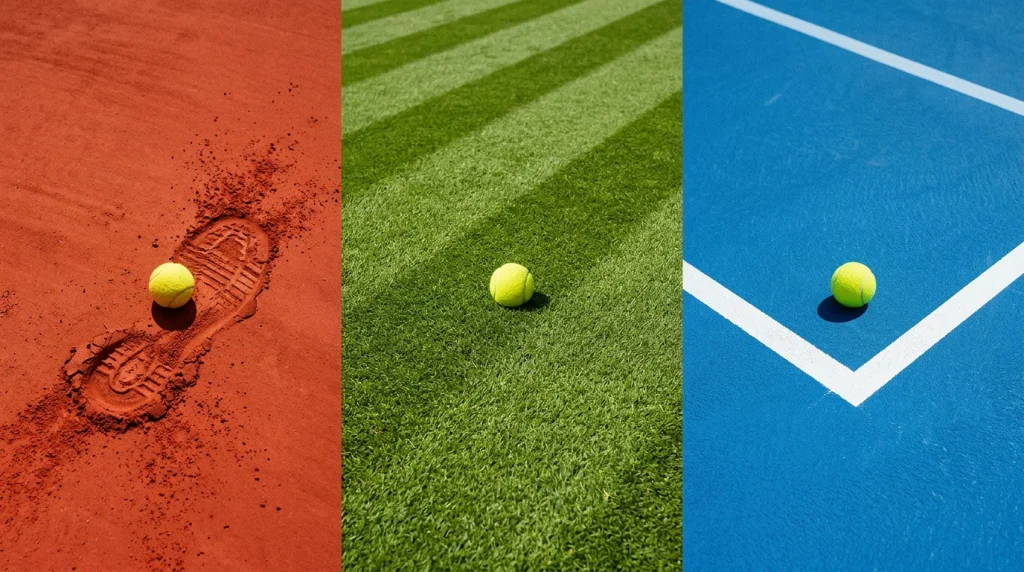
Surface Variations and Statistical Betting Impacts
I keep coming back to one number whenever someone asks me what matters most in tennis betting: 69% versus 75%. That is the difference in first-serve points won between clay and both grass and hard courts, according to a PLOS ONE academic study analysing Grand Slam match data. Six percentage points does not sound dramatic. In practice, it reshapes every betting market on the board. These surface metrics become incredibly important during the short grass season, especially when analyzing Wimbledon betting odds and draw dynamics.
Those six points represent thousands of additional return points in play across a tournament. They translate into more breaks of serve, longer sets, higher total game counts and a wider distribution of outcomes. On grass, the surface rewards the server so heavily that matches become tight, low-break affairs where the favourite almost always holds. On clay, the returner has a fighting chance on nearly every game, which means upsets are more common and the gap between the favourite’s implied probability and their actual win rate narrows.
Most tennis betting content describes surfaces in qualitative terms. Clay is “slow,” grass is “fast,” hard court is “medium.” That is true as far as it goes, which is not very far. Knowing that clay is slower than grass does not help you decide whether to take overs or unders on a total games line. Knowing that the server’s first-delivery win rate drops by six percentage points on clay compared with grass tells you exactly how much extra break pressure the returner gains, how many additional games that generates per set and what that means for the total games market. The qualitative description is a starting point. The quantitative difference is the edge.
This article puts numbers on each surface, drawn from academic research and tour-level data, and shows how those numbers translate into specific betting decisions on handicaps, totals and match winner markets. I cover each surface individually, then look at the transition periods between surfaces. These are, in my experience, the most consistently mispriced windows in the entire tennis calendar. The surface is not background information. It is the primary variable that every other betting decision should be filtered through.
Clay Court Betting: Where Rallies Erode Serve Dominance
My most profitable surface, year after year, is clay. Not because I have some special insight into the Roland-Garros draw, but because clay produces the most predictable deviations from generic bookmaker models. The surface punishes servers and rewards returners in ways that are measurable, consistent and persistently underpriced in certain markets.
The core mechanism is bounce. Clay courts produce a higher, slower bounce than any other surface, which gives the returner extra milliseconds to read the serve and position for the return. The win rate on first serve drops to 69% on clay, the lowest of any surface at Grand Slam level. That suppression of serve effectiveness cascades through the entire match structure. Hold rates fall. Break frequency rises. Sets that would finish 6-3 or 6-4 on a hard court stretch to 7-5 or 6-4 with multiple break exchanges on clay.
Rafael Nadal’s career clay win rate of 90.5% across 63 titles was the ultimate expression of what happens when a player’s game is perfectly calibrated to these conditions. But Nadal was the exception that proved the rule: for most players, clay is the great equaliser. A player ranked 50th in the world has a better chance of taking a set from a top-ten opponent on clay than on any other surface, purely because the serve advantage that protects higher-ranked players is diminished.
For betting, this translates into three practical edges. First, total games overs are structurally favoured on clay. More breaks mean more competitive sets, which push game counts higher. If a bookmaker sets a total games line at 22.5 for a clay match between two baseline players, the historical data suggests overs hit more frequently than the price implies. Second, underdog set handicaps (+1.5 sets) are stronger on clay because the underdog is more likely to win at least one set. Third, match winner prices on clay favourites are often too short. The market overestimates the favourite’s ability to dominate on a surface that actively works against dominance.
The clay season runs from late March through early June, with the calendar concentrated around European tournaments. Monte Carlo, Madrid, Rome and Roland-Garros are the headline events, but the edges are often sharper at 250-level clay events where bookmaker models are less refined and market liquidity is lower.
One nuance worth noting: not all clay courts are equal. The red clay used at Roland-Garros is slower and produces a higher bounce than the green clay (Har-Tru) used at some lower-level events. Altitude also matters. Madrid, at over 650 metres above sea level, plays faster than Rome because the thinner air reduces ball drag. A clay court in Madrid and a clay court in Monte Carlo are technically the same surface category but produce measurably different playing conditions. If you are betting on clay with serious intent, tracking these variations within the surface category adds another layer of precision to your analysis.
Grass Court Betting: Short Rallies, High Variance
Grass is the surface where I have learned to respect variance. The rallies are shorter, the serve is king and the margins between winning and losing are razor-thin. A single break of serve can decide a set, and a single set can decide a match. That compression makes grass simultaneously the most exciting and most frustrating surface for bettors.
Service points won on grass typically exceed 70% for top-tier players. The low bounce and fast pace give the server an advantage that is hard to neutralise regardless of the returner’s skill. Roger Federer’s grass court win rate of approximately 87% between 2011 and 2020 was built on this dynamic. His serve was a weapon that the surface amplified, and his net game added a finishing layer that clay and hard court did not offer to the same degree.
The betting implications are distinctive. Total games lines on grass should lean toward unders in most matchups. When both players hold serve consistently, sets resolve in tiebreaks at 7-6 (13 games) or in straight hold patterns at 6-4 (10 games). The absence of breaks compresses the total. A best-of-three grass match between two strong servers frequently finishes between 19 and 23 total games, lower than the equivalent clay matchup by three to five games on average.
Tiebreaks become a significant market on grass. The probability of a set reaching 6-6 is highest on this surface because hold rates are highest. If you track tiebreak frequency by surface, grass produces tiebreaks in roughly 25-30% of sets at tour level, compared with 15-20% on clay. The “will there be a tiebreak” market is a natural fit for grass-court specialists whose matches revolve around the serve. When two big servers meet on grass (think of the classic serve-dominated Wimbledon encounters), the probability of at least one tiebreak in the match can exceed 60%. That is a market worth watching closely during the grass season.
The risk on grass is variance. Because so few break opportunities arise, the outcome often hinges on a handful of points. A double fault at 4-4 in the second set can swing a match entirely. This randomness means grass-court results are harder to model reliably, and upset rates on match winner are lower but the upsets that do occur tend to be sharp and poorly predicted by the odds. My approach on grass is to reduce stake sizes compared with clay — the edges are real but the variance demands respect.
Hard Court Betting: The Neutral Baseline
Hard court is where the bookmaker has the most confidence, and that confidence is earned. Roughly 56% of ATP tournaments are played on hard surfaces, according to tour scheduling data spanning 2016-2025. That volume means bookmaker pricing models are calibrated on the largest possible dataset, which makes finding mispricing harder than on clay or grass.
The first-serve conversion rate on hard courts sits at 75%, identical to grass at the Grand Slam level. But the similarity is deceptive. Hard court rallies are longer than grass, breaks are more common than on grass (though less common than clay) and the range of playing styles that succeed is broader. A serve-and-volley specialist can win on hard court. So can a pure baseliner. That tactical diversity makes outcomes harder to predict from surface data alone, because the surface itself does not strongly favour any single dimension of the game.
The edge on hard courts tends to come from context rather than surface mechanics. Indoor versus outdoor hard courts play differently. Indoor conditions remove wind, standardise bounce and slightly favour servers. Hard courts at altitude (locations above 500 metres) produce a faster, higher-bouncing ball that changes the serve-return dynamic. Humidity, temperature and court brand also matter: a plexicushion surface in Melbourne plays differently from a DecoTurf surface in New York, even though both are classified as hard court.
For betting purposes, I treat hard court as the control group. When I am evaluating a player’s form, I look at their hard court numbers first because the sample size is largest and the variance is lowest. If their hard court performance is stable and they are moving to clay or grass, the deviation from their hard court baseline tells me how much the surface transition will affect their results. Hard court is rarely where the biggest edges sit, but it is always where the most reliable baseline data lives.
That said, the sheer volume of hard court events means the aggregate opportunity is still significant. If you can find even a 1-2% edge on hard court matches across a full season, the number of available matches (more than half the tour schedule) means that small edge compounds across dozens or hundreds of bets. The challenge is consistency. Hard court rewards depth of analysis rather than surface-level shortcuts, which makes it the surface best suited to model-based approaches where you can systematically process large amounts of match data.
Surface Transitions: Why the First Tournament on New Ground Matters
The week after Roland-Garros is, in my experience, the single best window for finding value in the entire tennis calendar. Players who have spent five weeks grinding on clay are suddenly thrust onto grass, a surface that demands completely different movement patterns, timing and tactical instincts. The adjustment is not metaphorical — it is biomechanical. Sliding on clay becomes a liability on grass. The high-bouncing topspin that dominates on clay becomes a weakness on a surface where the ball stays low and skids through.
Bookmaker models handle surface transitions poorly because they weight recent results heavily. A player who reached the semi-finals of Roland-Garros carries that form momentum into their pre-match pricing for the first grass event, even though the surface switch invalidates much of the signal. Their clay form tells you they are fit, match-sharp and confident. It does not tell you they can return a grass-court serve or finish points at the net.
The reverse transition, grass to hard court, is less dramatic because hard court is the tour’s default surface and most players are well-practised on it. But it still matters. The first hard court event after Wimbledon often sees erratic results from players who went deep on grass and have not played a hard court match in six weeks. The ITIA’s Karen Moorhouse has noted that player fitness, fatigue and playing conditions all drive unusual betting patterns, and surface transitions are a textbook example of a condition change that the market misprices.
My approach during transition windows: identify players with poor cross-surface records, wait for the market to price them based on their recent (wrong-surface) form, and look for value on the opposing side. It does not work every time. But over a season, the edge from transition mispricing has been one of my most consistent sources of profit.
The data supports this. Players who reached the quarter-finals or better at Roland-Garros and then entered a grass event the following week have historically underperformed their pre-match odds in the first round of that grass tournament. The effect is not enormous. It does not turn a 1.30 favourite into a loser, but it consistently reduces the actual win rate below the implied probability. When a market misprices a first-round grass match by even 3-4 percentage points because it is overfitting the player’s clay results, that gap is enough to build a positive expected value position on the opposing side. The surface did not change the player’s talent. It changed the relevance of the data the market was using to price the match.
How Surface Affects Over/Under and Handicap Lines
Total games and handicap lines are the two markets where surface data has the most direct impact. The mechanism is straightforward: surfaces that produce more breaks produce longer matches, which pushes totals higher and widens handicap spreads.
On clay, a best-of-three match between two evenly ranked players will average roughly 24-26 total games. The same matchup on grass averages 20-23. That is a three-to-five game gap driven almost entirely by the difference in break frequency. If a bookmaker sets a total games line at 22.5 for both matches, the clay match is statistically more likely to go over and the grass match more likely to go under. Some bookmakers adjust for this, but the adjustment is inconsistent, particularly at lower-tier events where the line-setter may be using a surface-agnostic model.
Handicap lines follow a similar pattern. On clay, where breaks are more evenly distributed, the favourite needs a larger game margin to cover a spread. A -4.5 game handicap on a clay court favourite requires winning at least five more games than the opponent, a tall order on a surface where the underdog is breaking serve regularly. On grass, the same -4.5 line is more likely to be covered because the favourite’s serve is a stronger shield and the underdog has fewer opportunities to claw games back.
The practical takeaway is to adjust your default expectations by surface before looking at any specific match. Clay: lean toward overs on totals and toward underdog handicaps. Grass: lean toward unders on totals and toward favourite handicaps. Hard court: treat the line at face value and look for match-specific factors rather than surface-level edges. For a deeper dive into how total games lines are set and where value sits, the mechanics are worth understanding before the clay season starts.
The ATP Surface Calendar and When Each Edge Peaks
The ATP surface calendar is not random. It follows a seasonal logic that creates predictable windows for each type of surface edge. Understanding the rhythm of the calendar is the difference between applying surface knowledge reactively and applying it proactively.
The hard court season dominates the first quarter of the year, starting with the Australian Open in January and running through events in North America and the Middle East into early March. This is the longest continuous block of hard court tennis, and the pricing models are at their sharpest because the data is fresh and voluminous. Edges here are harder to find but not impossible, especially in the early weeks when players are returning from the off-season with variable fitness levels.
Clay takes over from late March through early June. The European clay season builds through 250 and 500 events before peaking at the Masters 1000 in Monte Carlo, Madrid and Rome, then culminating at Roland-Garros. The edges I described earlier (overs on totals, underdog handicaps, shorter-priced favourites offering poor value) are strongest during this window. The sheer volume of clay events also means more matches to bet on, which helps with sample size if you are tracking a system.
Grass is the shortest and most concentrated season: roughly four weeks between Roland-Garros and Wimbledon, with a handful of events in the UK, Germany and the Netherlands. The compressed window means players have very few matches to adjust, which amplifies the transition effects discussed above. Wimbledon itself is the centrepiece, and the betting markets around it are the deepest of the grass season. Post-Wimbledon, the tour returns to hard court for the remainder of the year.
The late-season hard court swing, from the US Open in late August through the Asian events and indoor European tournaments in October-November, is where fatigue edges peak. Players who have been competing since January are running on depleted reserves. The surface itself is not the edge here — it is the calendar position. A player entering their twenty-fifth tournament of the year on hard court is a fundamentally different proposition from the same player entering their fifth tournament on the same surface back in February. The calendar tells you when each edge is sharpest. The numbers tell you how sharp. Find the most accurate surface statistics and betting edges on the premier tennis betting guide.
Surface Betting Questions
Which tennis surface produces the most upsets?
Clay produces the highest upset rate of any surface. The suppressed serve effectiveness (first-serve points won at 69% versus 75% on grass and hard courts) gives lower-ranked players more competitive games and more break opportunities. This flattens the outcome distribution and makes it harder for favourites to dominate. The effect is strongest in best-of-three matches, where a single tight set can decide the result.
How do indoor hard courts differ from outdoor hard courts for betting?
Indoor hard courts remove wind, standardise bounce and slightly favour servers because the conditions are controlled. Ace counts tend to be higher indoors, and total games tend to be lower. Bookmakers do not always distinguish between indoor and outdoor hard court in their models, which creates opportunities for punters who track the difference. Indoor events in the late season also carry fatigue factors that further separate them from outdoor hard court events earlier in the year.
Do weather conditions on clay affect totals more than on grass?
Yes. Rain interruptions on clay extend match duration, disrupt rhythm and often benefit the player with stronger mental composure rather than stronger serve. Humidity on clay makes the ball heavier and slower, which increases rally length and pushes totals higher. On grass, rain delays have a different effect because the surface becomes slippery, which can shorten rallies as players avoid aggressive movement. Weather matters on both surfaces, but the direction of impact differs.
