
Sportradar Tennis Data and TDI Betting Metrics
 Available in US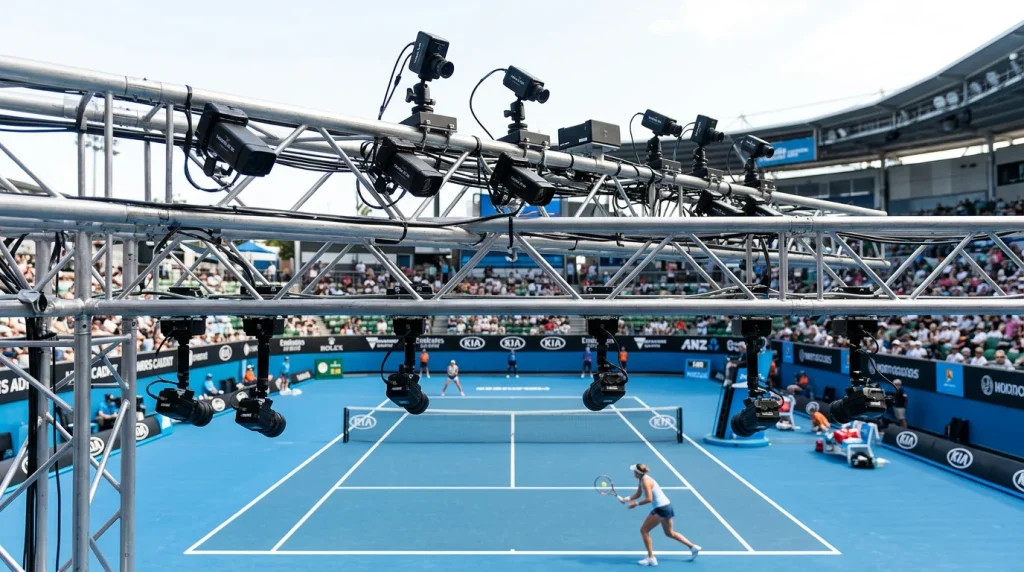
Official Data Infrastructure for Tennis Betting Odds
When Sportradar acquired IMG Arena’s global betting rights portfolio for £225 million in 2025, it was not just a corporate transaction — it was a structural shift in how tennis data reaches the betting market. Before that deal, the tennis data supply chain was fragmented: multiple providers held different licensing agreements, bookmakers cobbled together feeds from various sources, and the quality of live match data varied dramatically between operators. After the acquisition, Sportradar consolidated the most comprehensive tennis data operation in the industry under one roof.
For bettors, the practical impact was subtle but significant. The bookmakers who previously relied on unofficial or secondary data feeds gained access to higher-quality official data, which meant their in-play odds became more accurate and more responsive. The in-play edge that used to exist from data latency — where one bookmaker’s feed was faster than another’s, narrowed. The competitive landscape shifted from information speed to analytical depth: the raw data is now more uniform across operators, so the edge sits in how you interpret it rather than how fast you receive it.
What TDI Does for 14,500 Matches a Year
Tennis Data Innovations is the joint venture that manages the official data rights for the ATP Tour and ATP Challenger Tour. TDI processes live data from more than 14,500 matches annually, covering everything from Grand Slams to remote Challenger events in developing markets. Each match generates point-by-point data — serve speed, placement, rally length, winner and error counts, that flows through TDI’s systems to licensed betting operators.
The scale of that operation is worth understanding because it determines the quality of the odds you see. A Grand Slam match on Centre Court at Wimbledon has multiple data collectors, Hawk-Eye ball-tracking, broadcast video confirmation, and real-time quality checks. A Challenger match on an outside court in a small city may have a single data collector entering points manually on a tablet. The data from both matches feeds into the same odds engine, but the confidence level is vastly different, and the bookmaker’s margin on the Challenger match is wider to compensate for the higher error rate in the underlying data.
Carsten Koerl, CEO of Sportradar, described the partnership as an opportunity to apply computer vision and artificial intelligence to create new products for the tennis betting market. That vision is starting to materialise in the form of automated serve classification, ball trajectory prediction, and real-time expected win probability overlays that feed directly into the integrity monitoring systems as well as the commercial odds engines.
The IMG Arena Acquisition and Its Market Impact
IMG Arena held licensing agreements for tennis betting data across multiple tours and events. When Sportradar absorbed that portfolio, it eliminated a major competitor in the tennis data space and created a near-monopoly on official ATP data distribution to the betting industry. The competitive effect was predictable: operators who had previously used IMG Arena as their primary data source transitioned to Sportradar’s infrastructure, and operators who used both were able to consolidate onto a single platform.
The market impact for bettors was threefold. First, the quality of live data improved as Sportradar invested in the integrated platform, reducing the frequency of data errors that caused incorrect odds movements. Second, the uniformity of data across operators increased, which reduced the arbitrage opportunities that existed when different bookmakers used different data feeds. Third, the cost of data increased for operators, which some passed on through slightly wider margins on lower-tier matches where the data cost per match is highest relative to the betting volume.
For the informed bettor, the consolidation shifted the source of edge. Before the acquisition, speed was king — getting data before the bookmaker processed it was a genuine advantage. After the acquisition, interpretation became king. The data arrives at roughly the same speed to all operators, so the bettor who can interpret the data faster or more accurately than the bookmaker’s automated model holds the edge. That means deeper knowledge of serve mechanics, surface dynamics, and player tendencies — the analytical work that no data feed can automate.
Full Electronic Line Calling and What It Means for Data Quality
The ATP implemented full electronic line calling via Hawk-Eye across all tour events beginning in 2025, eliminating human line judges from every ATP match. The primary motivation was improving the on-court experience and reducing disputes, but the secondary effect was equally important for the betting ecosystem: every ball in every rally now has a verified trajectory, speed, and landing position recorded digitally.
For the data layer behind betting odds, Hawk-Eye’s full deployment standardised the measurement of serve speed, serve placement, and ball trajectory across all ATP venues. Before 2025, serve speed measurements at different venues used different equipment with different calibration standards, which meant that a “200 km/h serve” at one venue was not precisely comparable to a “200 km/h serve” at another. Full Hawk-Eye deployment eliminated that variance, making cross-venue serve data directly comparable for the first time.
The betting implication is cleaner models. When the serve speed input is standardised, the pricing engine can weight it more confidently, which produces tighter lines and more accurate pre-match odds. For bettors, tighter lines mean smaller edges per bet — but they also mean that genuine edges are more reliable when they appear, because the baseline pricing is more accurate. The market has become harder to beat on average but more predictable when you do find a genuine mispricing, which rewards depth of analysis over breadth of betting activity.
The tennis data infrastructure is more sophisticated than most bettors realise, and understanding it provides context for why odds move the way they do. Every in-play price adjustment, every pre-match line movement, and every market suspension is driven by data flowing through the TDI-Sportradar pipeline. Knowing the strengths and limitations of that pipeline — where the data is strongest (Grand Slams with full Hawk-Eye) and where it is weakest (Challenger events with manual entry) — is a genuine informational advantage that sits outside the data itself.
How does official ATP data differ from unofficial tennis data sources?
Official ATP data from TDI and Sportradar is collected by trained courtside operators with quality checks and, at tour-level events, verified by Hawk-Eye ball-tracking. Unofficial sources rely on manual entry by less trained observers, broadcast feeds with inherent delays, or crowd-sourced data. The difference shows in accuracy and speed — official data has fewer errors and reaches bookmakers 1-5 seconds faster than unofficial sources.
Did the Sportradar-IMG Arena deal change the quality of tennis odds?
Yes. The consolidation improved data uniformity across operators, reduced errors in live data feeds, and standardised serve speed measurements. In-play odds became more accurate and more responsive at tour-level events. However, the improved data also narrowed the edges available from data latency, shifting the source of betting value from speed to analytical depth.
