
Tennis Total Games Over/Under Betting Odds
 Available in US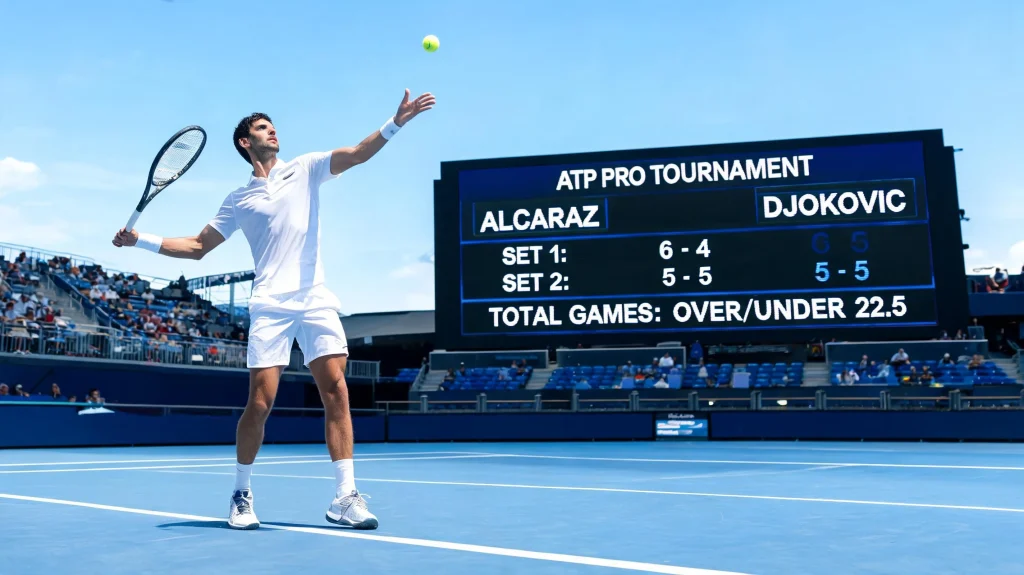
Calculating Value in Game Totals and Match Pricing
I placed my first over/under bet on tennis because I did not have an opinion on who would win. Two evenly matched players, both priced around 1.90, and I could not separate them. But I could see that both had serve percentages above 65% and hold rates above 82% — a combination that almost always produces tight sets and high game counts. I backed over 22.5 games and it landed in a three-set match that finished 7-5, 4-6, 7-6. That was the moment I realised totals are not a consolation market. They are the primary market for anyone with serve data.
The total games line in tennis is the number of games the bookmaker expects the match to produce. If the line is set at 21.5 for a best-of-three match, the bookmaker is pricing a match duration of roughly 22 games — think 6-3, 6-4. You bet over if you expect more games, under if you expect fewer. The key insight is that total games in tennis are driven almost entirely by serve dominance, because when both players hold serve comfortably, sets go deep and tiebreaks become likely.
The Serve Metrics That Drive the Line
Three numbers predict total games in tennis better than anything else: first serve points won percentage, hold percentage, and break points faced per service game. When both players have high values across all three, the match trends toward overs. When one player has a significant advantage — particularly in return points won, the match trends toward unders because the stronger returner breaks early and closes sets at 6-3 or 6-4.
I build a simple expected games model using hold rates. If Player A holds 85% of the time and Player B holds 80%, the expected number of service holds per set is 10.5 holds out of 12 service games. That translates to a set score close to 6-5 or a tiebreak, producing 12-13 games per set. In a best-of-three, that is 25-26 total games, which puts overs well above the typical line of 21.5 to 23.5.
Surface splits the serve data in ways that matter enormously. The PLOS ONE research showing first serve point won rates of 75% on grass versus 69% on clay translates directly into totals pricing. On grass, high hold rates push matches toward tiebreaks and overs. On clay, more breaks of serve produce shorter sets and lower totals. A totals line of 22.5 might be an overs play on grass between two servers but a comfortable unders on clay between two baseliners. Context is everything.
Where the Market Misprices Totals
The most consistent mispricing I have found in tennis totals is in first-round Grand Slam matches between a seed and a qualifier. The market sets the line based on the ranking gap, expecting a quick straight-sets win with a low total. But qualifiers who survive three rounds of qualifying to reach the main draw are match-fit, confident, and often serving well. Their hold percentage in qualifying is the overlooked data point. A qualifier holding above 80% in their qualifying matches will not be brushed aside 6-2, 6-1 — they will hold most of their service games and push the match toward 20+ games even if they lose in straights.
Another mispricing zone: WTA matches between players ranked 15th to 40th. The prediction models struggle with this range because the performance variance is high. Two players ranked 20th and 30th might produce a 6-1, 6-2 one week and a 7-6, 4-6, 7-5 the next. The market averages this out, but the specific matchup — serve versus return, baseline versus aggressive, determines where the total will land. Taking the time to analyse the stylistic matchup, rather than just the rankings, reveals overs or unders value that the ranking-based line misses.
In-Play Totals and the Mid-Match Adjustment
Ninety percent of tennis bets at Entain are placed in-play, and the totals market is one of the best in-play opportunities. After the first set, you have fresh data on both players’ serve and return performance in the specific conditions of the match — the court speed, the ball weight, the wind. The pre-match totals line was based on historical data, but the in-play line adjusts to what is happening on court.
My in-play totals approach is straightforward. If the first set goes to a tiebreak (13 games), the match is running ahead of the pre-match total. The in-play line adjusts upward, but it often does not adjust enough because the model assumes the second set might be more one-sided. If I have seen both players serving well and holding comfortably through the first set, I take the in-play overs for the match total because the serve dynamics that produced the first-set tiebreak are likely to continue.
The reverse applies too. If the first set finishes 6-1 in 25 minutes, the in-play total drops sharply. But a 6-1 set sometimes reflects a slow start from one player rather than genuine domination. If the losing player’s serve stats in the 6-1 set show they hit a reasonable first serve percentage but lost several deuce games, they are closer to the winner than the score suggests. The in-play unders line after a lopsided first set can overcorrect, creating overs value for the rest of the match.
Building Your Totals Approach Match by Match
Total games betting rewards discipline and data over instinct. My process for every totals bet starts with the same three metrics — first serve points won, hold rate, and break points faced, filtered by surface over the past 12 months. I convert those into an expected total, compare it with the bookmaker’s line, and bet only when the gap is at least two games. That two-game threshold keeps me out of marginal spots where the overround eats into the edge. Over nine years, totals betting has been my most consistent tennis market because the inputs are quantifiable and the outputs are measurable. No guessing who will win, just counting the games.
What is a good over/under total games line for tennis?
The typical total for a men"s best-of-three match is 21.5 to 23.5 games. For a Grand Slam best-of-five, lines range from 35.5 to 39.5. Women"s best-of-three totals are similar to men"s. The "right" line depends on serve metrics and surface — two big servers on grass will push the total higher than two baseliners on clay.
How does surface affect total games in tennis?
Grass produces the highest totals because serve dominance leads to more tiebreaks. Clay produces lower totals because breaks of serve shorten sets. Hard courts sit between the two. First serve point won rates — 75% on grass and hard courts, 69% on clay, are the key driver of this surface difference.
